
Updated - April 2026
Nova Scotia Income Tax Calculator: What Your Paycheque Actually Means
Most people know roughly what they earn. Far fewer know what they actually take home — and the gap between those two numbers is where confusion, missed planning, and quiet financial stress tend to live. If you’re working in Nova Scotia, or thinking about relocating there, getting your head around how the province taxes your income isn’t optional — it’s the starting point for every smart money decision you’ll make.
This guide walks through the Nova Scotia income tax calculator, how it works, how to use it step by step, and — importantly — what the numbers actually mean for your daily life.
What Is a Nova Scotia Income Tax Calculator?
A Nova Scotia income tax calculator is an online tool that estimates how much provincial and federal tax you’ll owe based on your gross income, filing status, and certain deductions. You plug in your numbers, and it outputs your estimated net pay — the amount that actually lands in your account.
Think of it like a rough draft of your tax return, done in under a minute. It won’t replace a certified accountant for complex situations, but for most salaried employees, freelancers, and part-time workers, it gives a clear and reliable picture.
The calculation combines two layers:
- Federal income tax — set by the Canada Revenue Agency (CRA) and applied to all Canadians
- Provincial income tax — set by Nova Scotia, applied on top of your federal obligation
The Nova Scotia income tax calculator handles both layers simultaneously, which is what makes it genuinely useful rather than just half the answer.
Why Is the Nova Scotia Income Tax Calculator Important?
Here’s the thing: Nova Scotia has one of the higher combined tax rates among Canadian provinces, particularly for middle and higher income earners. That’s not a criticism — it reflects the province’s public services and social programs — but it does mean that without running the numbers, your take-home estimate could be significantly off.
Say you’ve been offered a job at $75,000 per year. Do you know what that translates to monthly, after both layers of tax? Most people guess wrong by $300 to $600 a month. That’s not a small error when you’re setting a housing budget or deciding whether to accept an offer.
Using a Nova Scotia income tax calculator gives you:
- An accurate picture of your real monthly income
- A basis for comparing job offers with different salaries
- A way to understand how a raise actually changes your take-home
- Clarity before making big financial commitments like a mortgage or lease
If you’re also thinking about long-term financial decisions, tools like the compound interest calculator and savings goal calculator pair well with this one — because knowing your real take-home is step one of any honest savings plan.
How Nova Scotia Income Tax Is Actually Calculated
Before using the calculator, it helps to understand what’s going on under the hood.
Federal Tax Brackets (2024)
Canada uses a progressive federal tax system. The more you earn, the higher the rate on each additional dollar — not on your total income.
| Taxable Income | Federal Rate |
|---|---|
| Up to $55,867 | 15% |
| $55,867 to $111,733 | 20.5% |
| $111,733 to $154,906 | 26% |
| $154,906 to $220,000 | 29% |
| Over $220,000 | 33% |
Nova Scotia Provincial Tax Brackets (2024)
Nova Scotia adds its own layer on top of your federal tax:
| Taxable Income | Provincial Rate |
|---|---|
| Up to $29,590 | 8.79% |
| $29,590 to $59,180 | 14.95% |
| $59,180 to $93,000 | 16.67% |
| $93,000 to $150,000 | 17.50% |
| Over $150,000 | 21.00% |
Basic Personal Amounts
Both layers include a basic personal amount — the portion of income you earn tax-free before any rate applies. For 2024, the federal basic personal amount is approximately $15,705. Nova Scotia’s is $8,481. These automatically reduce your taxable income.
A Quick Example
If you earn $65,000 per year in Nova Scotia:
- Subtract the basic personal amounts and any standard deductions
- Apply federal brackets progressively to the remainder
- Apply provincial brackets progressively on top
- The result is your total tax owing — typically somewhere around $14,000 to $16,000 combined for that income level, leaving you with roughly $49,000 to $51,000 take-home
That’s the math in brief. The calculator does all of it automatically.
How to Use the Nova Scotia Income Tax Calculator — Step by Step
Using the Nova Scotia income tax calculator on YourCalculatorHub takes less than two minutes. Here’s the process:
Step 1: Enter your gross annual income. This is your income before any deductions — your full salary, or your estimated annual freelance earnings.
Step 2: Select your province. Choose Nova Scotia. This ensures the correct provincial brackets and rates are applied.
Step 3: Enter any RRSP contributions. Registered Retirement Savings Plan contributions directly reduce your taxable income. If you contribute $5,000 to your RRSP, you only pay tax on your income minus that $5,000. This is one of the most effective legal ways to reduce your bill.
Step 4: Include other deductions if applicable. Some calculators allow for union dues, childcare expenses, or other deductions. Enter what applies to your situation.
Step 5: Review your output. The calculator will display your estimated federal tax, provincial tax, CPP contributions, EI premiums, and final net income — both annually and monthly.
That monthly net income figure is the number worth writing down. It’s your real budget baseline.
Real-Life Scenarios: What Different Incomes Look Like After Tax
Numbers mean more in context. Here are three typical Nova Scotia income levels run through the tax calculator.
Scenario 1: $45,000 Annual Salary
A starting salary common in healthcare support, education, or trades:
- Estimated combined tax: approximately $8,800–$9,400
- CPP + EI: roughly $3,200
- Approximate monthly take-home: $2,700–$2,850
Scenario 2: $75,000 Annual Salary
Mid-career professional, many Nova Scotia government and tech roles:
- Estimated combined tax: approximately $17,000–$19,000
- CPP + EI: roughly $3,700 (maxed)
- Approximate monthly take-home: $4,200–$4,500
Scenario 3: $120,000 Annual Salary
Senior professional, doctor, engineer, or experienced manager:
- Estimated combined tax: approximately $38,000–$41,000
- CPP + EI: capped at similar amounts
- Approximate monthly take-home: $6,500–$6,900
These are estimates — your actual numbers will shift depending on RRSP contributions, eligible deductions, and other credits. But as planning benchmarks, they’re close enough to be genuinely useful.
If you’re a freelancer or self-employed, you’ll also need to factor in CPP self-employment contributions, which are doubled compared to salaried employees. The self-employed CPP contribution calculator handles this specifically.
Benefits of Using a Nova Scotia Income Tax Calculator
The practical advantages go beyond just curiosity.
Salary negotiation. When you know your effective tax rate, you can negotiate with clarity. A $5,000 raise sounds different once you know it translates to roughly $2,800 in your pocket after tax.
Budget planning. You can’t build a real budget on gross income. Monthly net income is the only number that matters for rent, groceries, savings, and bills. Tools like the loan and mortgage calculator become much more accurate once you have your real take-home number.
RRSP strategy. The calculator helps you see exactly how much your RRSP contribution saves you in tax. At $75,000 income in Nova Scotia, a $6,000 RRSP contribution can reduce your combined tax bill by $1,800 or more — that’s not a small number.
Relocation decisions. Comparing a $70,000 job in Halifax to the same salary elsewhere? The tax difference matters. Nova Scotia’s rates are higher than Alberta’s, for example, which has no provincial income tax. Running both through calculators gives you an honest comparison. You can browse Canada Calculators on YourCalculatorHub to compare across provinces.
Limitations and Things to Keep in Mind
A Nova Scotia income tax calculator is a planning tool, not a tax filing service. There are a few things it won’t capture:
Investment income. Dividends and capital gains are taxed differently from employment income. If you have investment income, a standard calculator won’t give you the full picture. The Canada capital gains tax calculator handles that side separately.
Tax credits beyond the basics. Nova Scotia offers specific provincial credits — for low-income earners, seniors, and people with disabilities — that a general calculator may not include. These can meaningfully reduce your bill.
Irregular income. Freelancers and contract workers with variable monthly income should treat the annual figure as an average, then set aside tax as a consistent percentage throughout the year rather than waiting until filing season.
Spousal and family deductions. Married couples and those with dependents have additional credits available. A calculator gives you a starting point, but a tax professional adds real value here.
The CRA’s official guidance is the definitive source for filing requirements. The Canada Revenue Agency website and Nova Scotia’s provincial tax information are both worth bookmarking.
Related Calculators Worth Knowing
If you’re thinking about your full financial picture, these tools connect naturally with the income tax calculator:
- RRSP Growth Calculator — see how regular contributions compound over time
- Canada Take-Home Pay Calculator — broader view across all deductions
- TFSA Contribution Room Calculator — maximize your tax-free savings
- Hourly to Annual Salary After Tax Canada — for hourly workers converting to annual equivalents
- Ontario HST Calculator — if you work across provincial lines
- Weekly Payroll Tax Calculator Canada — for weekly pay period breakdowns
- Loan Calculator — plan borrowing against real take-home income
Browse all Canada Calculators on YourCalculatorHub.
FAQs About the Nova Scotia Income Tax Calculator
What is the basic personal amount for Nova Scotia in 2024? Nova Scotia’s basic personal amount for 2024 is $8,481. This is the portion of your income that is not subject to provincial tax.
Does the calculator include CPP and EI deductions? Most income tax calculators for Canada include CPP (Canada Pension Plan) and EI (Employment Insurance) deductions, since these are mandatory and affect your take-home pay. YourCalculatorHub’s Nova Scotia calculator includes these.
How accurate is an online income tax calculator? For straightforward employment income with standard deductions, an online calculator is generally accurate to within a small margin. Complex situations — multiple income sources, investment income, self-employment — benefit from professional review.
Can I use the calculator if I’m self-employed? You can use it for a rough estimate, but self-employed individuals also owe the employer portion of CPP, which doubles that contribution. Use the self-employed CPP calculator alongside.
What’s the highest tax rate in Nova Scotia? The top combined rate in Nova Scotia — federal plus provincial — reaches approximately 54% on income above $220,000. This is among the highest in Canada. For most earners, the effective combined rate is considerably lower.
Does Nova Scotia have a surtax? No. Nova Scotia uses a standard bracket system without a surtax, unlike Ontario which applies a surtax above certain provincial tax thresholds.
When should I consult an accountant instead of using a calculator? When you have investment income, run a business, have significant foreign income, or are filing for the first time after a major life change like marriage, inheritance, or self-employment. The calculator is a planning tool; an accountant is a professional advisor.
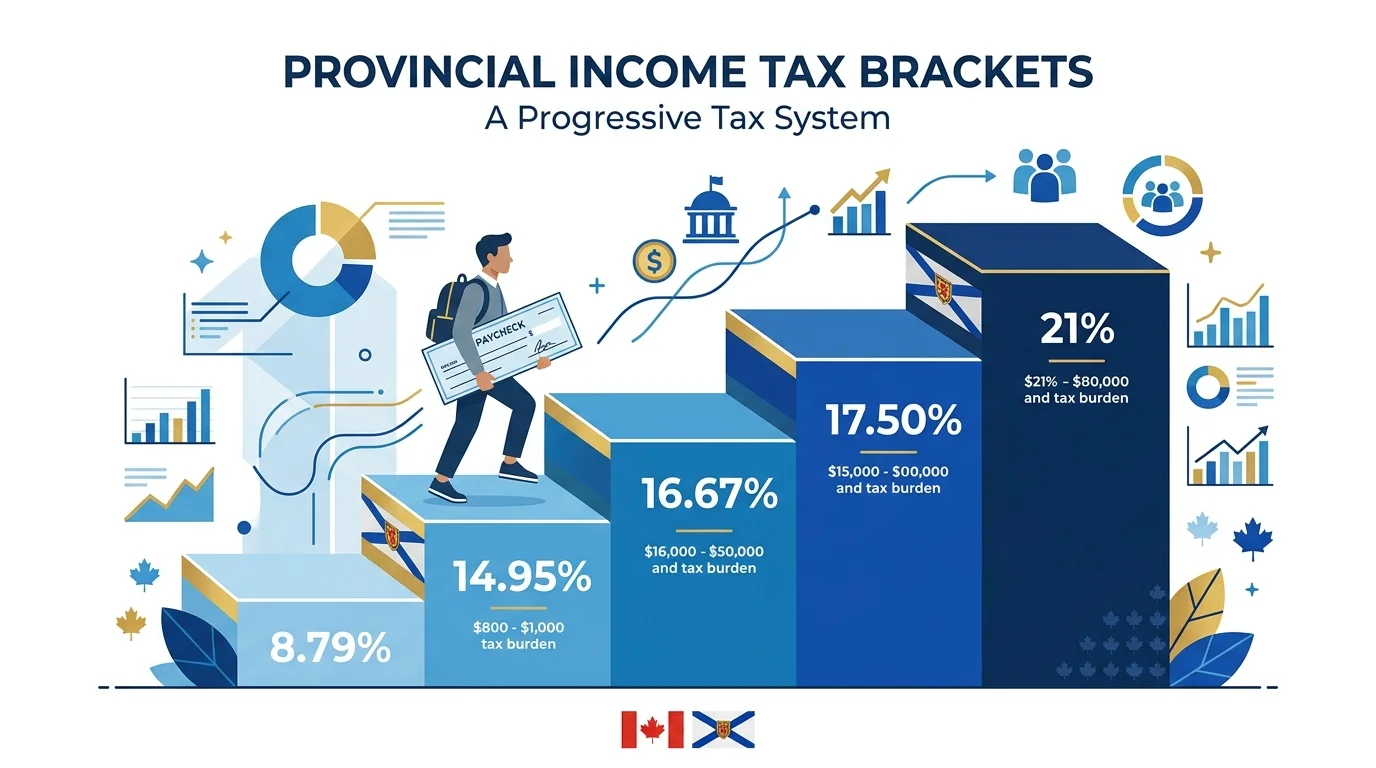 Nova Scotia uses a five-bracket progressive tax system — higher earnings are taxed at higher marginal rates, not your entire income.
Final Thought
Tax planning doesn’t have to be something you dread or defer until April. Knowing your real after-tax income isn’t just about the numbers — it’s about making decisions with accurate information rather than rough guesses.
The Nova Scotia income tax calculator is a small tool with a large practical value. Run your numbers before you agree to a salary. Run them before you sign a lease. Run them before you decide how much to put into your RRSP. It takes two minutes, and the clarity it gives you is worth far more than the time it costs.
What’s one financial decision you’ve been putting off because you weren’t sure about the tax side of it?
Disclaimer
The information in this article is provided for general educational and informational purposes only. It does not constitute financial, tax, or legal advice. Tax rates, brackets, and credits change annually and may differ based on individual circumstances. Always verify current figures with the Canada Revenue Agency or a qualified tax professional before making financial decisions. The calculator estimates are approximations and may not reflect your exact tax liability.
About the Author / Editorial Note
This article was researched and written by the editorial team at YourCalculatorHub, a resource dedicated to making financial and lifestyle calculations accessible to everyday users. Our content is reviewed for accuracy against current CRA guidelines and provincial tax schedules. We update financial content annually to reflect rate changes. For questions or corrections, visit our contact page or review our terms and conditions.