
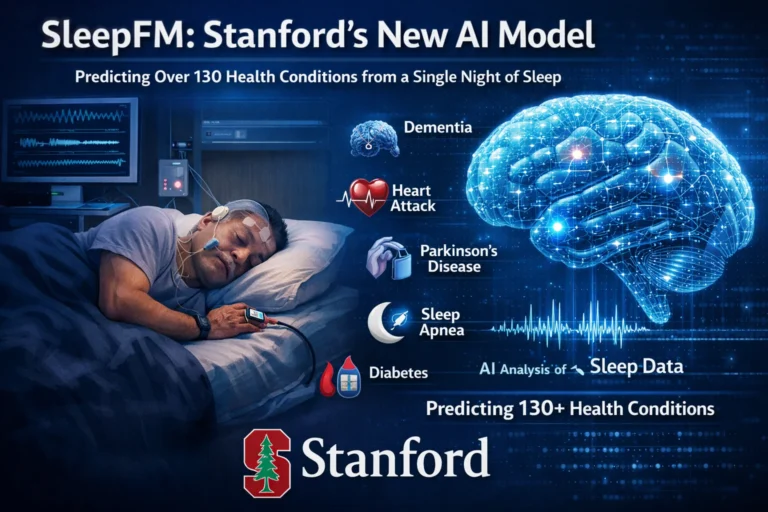
SleepFM: Stanford’s Groundbreaking AI Model That Predicts Over 130 Diseases Based on Just One Night of Sleep
Sleep, once simply a reflection of our well-being, has become something much more significant, thanks to recent strides in artificial intelligence. Stanford University researchers have unveiled SleepFM, an innovative AI foundation model. This model can forecast over 130 health conditions, all based on data gleaned from a single night’s sleep recording.
This represents a significant leap forward in digital health, preventive medicine, and AI-powered diagnostics. SleepFM shows how sleep data can reveal important information about the body, even before symptoms appear. This occurrence is true for neurological disorders like dementia and Parkinson’s disease, as well as cardiovascular problems such as heart attacks.
This article takes a close look at SleepFM: what it is, how it functions, its significance, and its potential to transform healthcare as we know it.
What Exactly Is SleepFM?
SleepFM, a foundational AI model, was developed using extensive sleep data. Its purpose is to analyze physiological signals collected during sleep to predict various health conditions.
Unlike traditional sleep analysis tools that focus on specific sleep disorders, SleepFM takes a more comprehensive approach, viewing sleep as a key indicator of overall health.
The model uses advanced machine learning structures, similar to those in large language models. However, instead of working with text, it learns patterns from sleep signals, such as:
Electroencephalography (EEG) is used to study brain activity.
(Learn more: https://www.ninds.nih.gov/health-information/disorders/electroencephalography-eeg)Heart rate and heart rate variability are important measurements.
(Reference: https://www.heart.org)Breathing patterns
Blood oxygen levels are a key indicator of how well the body is getting oxygen. These levels are usually measured in the arteries. They show how well the lungs and heart are working together to deliver oxygen to the body. Low blood oxygen levels can be a sign of problems with the lungs, heart, or blood flow. These problems can lead to serious health issues. Therefore, it’s important to regularly evaluate blood oxygen levels to determine and treat any potential health problems.
(Clinical overview: https://medlineplus.gov/bloodoxygenlevel.html)Human body movement and sleep stages
There is a close connection between human body movement and the different stages of sleep. The body’s physical activity is closely related to the different stages of sleep. These stages include light sleep, deep sleep, and REM sleep. Each stage is characterized by specific patterns of brain activity, muscle relaxation, and changes in heart rate and breathing. The body’s movements, such as muscle twitches or shifts in position, can happen during these sleep stages. These movements are often small and not noticeable, but they can affect the quality of sleep. Therefore, understanding how the body moves during sleep is important for understanding sleep disorders and finding ways to improve sleep.
SleepFM’s ability to identify subtle indicators related to both long-term and short-term illnesses comes from its ability to understand the complex relationships between these signals.
Why Sleep Data Packs a Punch
Sleep is a unique physiological state, marked by the body’s relative independence from outside influences.
During sleep, the body goes through a series of complex processes:
Memory consolidation is a process the brain uses.
The cardiovascular system undergoes a reset.
Hormones are regulated.
The immune system is activated.
Disruptions in these processes often leave measurable traces in sleep signals. Changes in sleep patterns can occur years before a clinical diagnosis in conditions like neurodegenerative diseases, metabolic disorders, and heart disease.
SleepFM uses this approach by analyzing sleep as a single, information-rich dataset, rather than looking at individual measurements.
SleepFM’s Functionality
1. Foundation Model Architecture
SleepFM is a foundational model, meaning it’s trained on large and diverse sleep datasets, which allows it to be adapted for various medical uses. This method allows the model to generalize across different populations, devices, and conditions.
Instead of creating separate AI models for each individual disease, SleepFM uses universal sleep representations. These representations can then be used to predict a variety of different outcomes.
2. Training on Large-Scale Sleep Recordings
The SleepFM model was trained using a large dataset of overnight sleep recordings. These recordings came from clinical sleep studies and data collected from wearable devices.
These recordings include labeled health outcomes, which allows the model to learn the connections between sleep patterns and specific diseases. The training process of SleepFM enables it to identify both obvious and subtle physiological changes, which human doctors might not readily perceive.
3. Single-Night Predictive Capability
SleepFM possesses the capability to forecast outcomes for a single night. It is truly remarkable that SleepFM can make predictions based on just one night’s worth of sleep data.
Traditional risk assessment methods often require a detailed medical history, laboratory tests, and imaging studies. SleepFM can make meaningful predictions using only overnight data.
SleepFM’s Predictive Health Insights
SleepFM has shown it can predict more than 130 health conditions across various medical fields.
Neurological Disorders
Sleep is closely linked to brain health, making it a potentially useful way to identify neurological disorders. SleepFM demonstrates impressive predictive capabilities in the following areas:
Dementia and cognitive decline
(Background: https://www.alzheimers.org.uk)Parkinson’s disease
(Clinical resource: https://www.parkinson.org)Epilepsy-related conditions
(Medical overview: https://www.cdc.gov/epilepsy)Neurodegenerative disease risk markers
Changes in sleep stages, brain wave patterns, and movement during sleep often appear before noticeable neurological symptoms.
Cardiovascular Diseases
Sleep physiology has a strong connection to heart health. SleepFM is capable of pinpointing risk factors and early warning signs for:
Heart attacks
Hypertension
Irregular heartbeats
Stroke-related conditions
The model learns to understand important information from changes in heart rate variability, oxygen saturation, and breathing patterns.
(Reference: https://www.who.int/health-topics/cardiovascular-diseases)
Metabolic and Endocrine Disorders
Disruptions to sleep are strongly linked to metabolic health. SleepFM offers insights into:
Type 2 diabetes
(Resource: https://diabetes.org)Obesity-related health problems
Hormonal imbalances
Metabolic syndrome
These predictions could be especially useful for early lifestyle changes and medical treatments.
Respiratory and Sleep-Related Conditions
SleepFM, though it offers much more than just standard sleep analysis, remains highly effective at identifying common sleep disorders, including:
Sleep apnea
(Clinical guide: https://www.sleepfoundation.org/sleep-apnea)Chronic respiratory problems
Patterns of oxygen desaturation
By combining these elements with a broader understanding of health, SleepFM provides a more complete diagnostic picture.
How SleepFM Differs From Traditional Sleep Analysis
Polysomnography, a common method in sleep studies, is mainly used to diagnose specific sleep disorders. These methods are often costly, require a lot of time, and usually react to problems instead of preventing them.
SleepFM is rolling out a few significant new features:
The focus is on prediction rather than diagnosis.
It spots potential health issues before they even show up.
Analyzing multiple conditions rather than a single disorder.
Scalability for wearable devices and home monitoring.
AI-powered insights that reveal patterns human analysis might miss.
Clinical and Real-World Applications
Preventive Healthcare
SleepFM could significantly change preventive medicine by enabling the early identification of potential health problems. Patients could receive alerts years before a traditional diagnosis, allowing for lifestyle adjustments, early medical interventions, and continuous disease monitoring.
Remote and At-Home Monitoring
With the increasing accuracy of wearable sleep trackers, SleepFM could be integrated into consumer devices. This would allow for advanced health screenings without needing hospital visits or invasive procedures, helping reduce healthcare costs and improve access.
Personalized Medicine
Because SleepFM learns individual sleep patterns, it can support personalized treatment plans. Therapies could be tailored based on how a patient’s body reacts during sleep, rather than relying solely on daytime measurements.
Ethical and Privacy Considerations
The ability to forecast health outcomes brings significant responsibility. Using sleep data raises concerns about data privacy, informed consent, responsible use of predictive health information, and avoiding unnecessary anxiety.
Researchers emphasize that SleepFM is designed to support clinicians, not replace them. Predictions should always be interpreted within a clinical context.
Limitations and Ongoing Research
Even though SleepFM is a significant advancement, it has some limitations. Predictions are probabilistic, not definitive diagnoses. Performance can vary across populations and devices. Clinical validation and regulatory approval are still required.
Ongoing research aims to enhance accuracy, minimize bias, and broaden supported sleep data sources.
The Future of AI and Sleep-Based Health Prediction
SleepFM is part of a broader healthcare trend involving AI foundation models. Just as large language models transformed natural language processing, models like SleepFM could become the backbone of future medical AI systems.
In the coming years, integration with electronic health records, continuous monitoring via wearables, AI-assisted preventive care, and earlier detection of chronic and neurodegenerative diseases are likely to become standard practice.
In Closing
SleepFM represents a significant shift in how sleep data is understood and used. Stanford researchers have demonstrated that a single night’s sleep can signal risk for over 130 health conditions, paving the way for a preventive, personalized, and accessible healthcare future.
As artificial intelligence continues to advance, our nightly sleep may become one of the most powerful diagnostic tools available, quietly working while we rest. SleepFM suggests that the future of healthcare may begin not in the clinic, but in sleep itself.