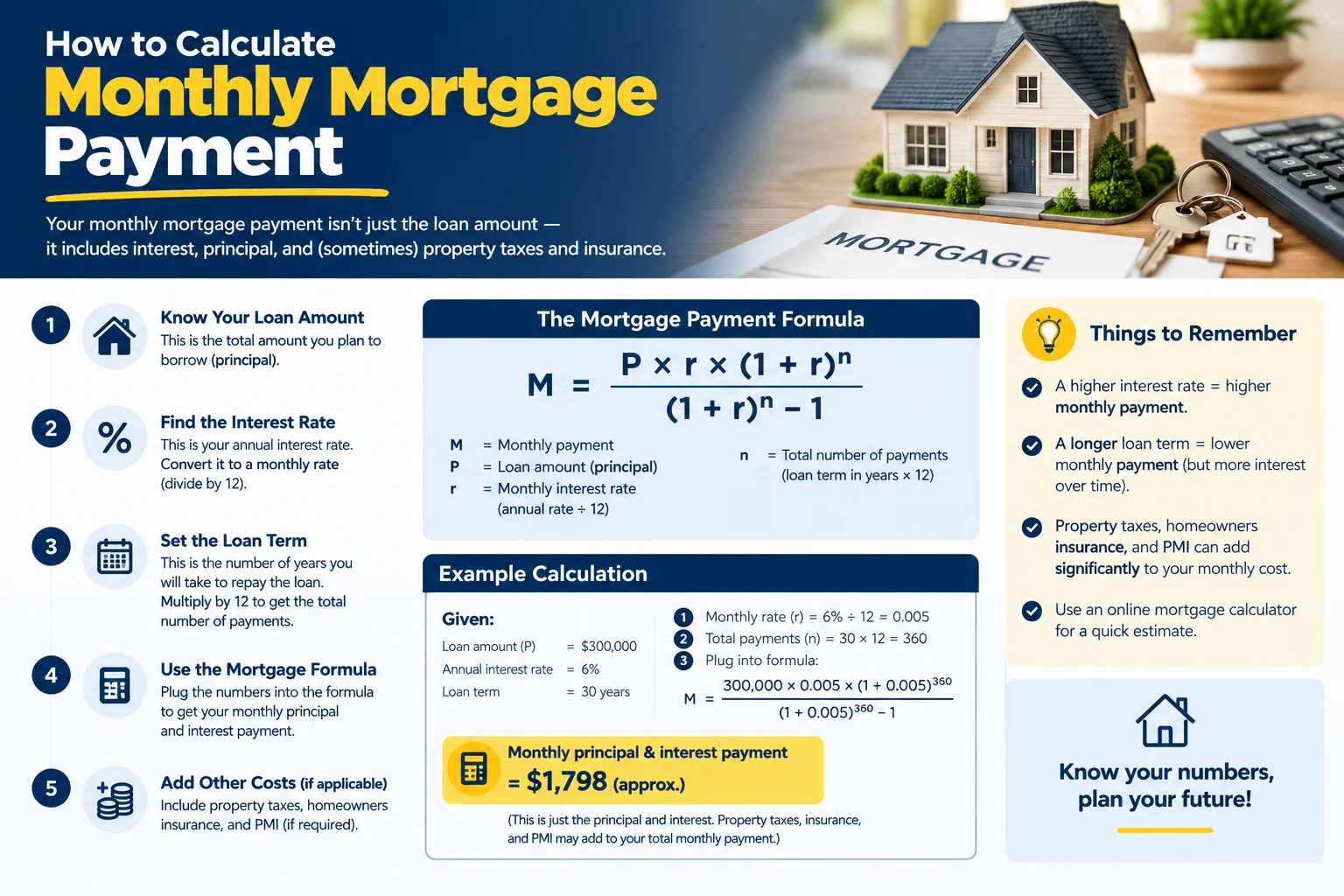
- The standard fixed-rate mortgage formula calculates principal and interest from the loan amount, monthly interest rate, and number of payments.
- The loan amount is usually the home price minus the down payment, plus any financed amounts that apply to the loan.
- A lower rate, smaller loan balance, or shorter term changes the monthly payment and total interest in different ways.
- Your total monthly housing cost can be higher than principal and interest because taxes, insurance, mortgage insurance, and other costs may apply.
- A mortgage calculator is best used to compare realistic scenarios rather than to treat one estimate as a guaranteed lender quote.
What Is a Monthly Mortgage Payment?
A monthly mortgage payment is the amount you pay toward a home loan on a recurring schedule. For a typical fixed-rate, fully amortizing mortgage, the principal-and-interest portion is designed to repay the borrowed amount over the agreed term while also covering the interest charged by the lender.
The phrase monthly mortgage payment can mean different things depending on the context. A calculator may show only principal and interest, while a lender's payment estimate may also include property taxes, homeowners insurance, mortgage insurance, or other applicable charges. That distinction matters when you are deciding whether a home fits your budget.
For the standard principal-and-interest calculation, you need three core inputs: the loan amount, the interest rate, and the loan term. If you want to estimate the broader monthly housing cost, add the applicable taxes, insurance, mortgage insurance, and other recurring costs separately.
What Information Do You Need?
Before calculating a mortgage payment, gather the numbers that describe the loan. The exact inputs can vary by calculator, but the following are the most useful starting points.
| Input | What It Means |
|---|---|
| Home price | The purchase price of the property. |
| Down payment | The amount paid upfront rather than borrowed. |
| Loan amount | The principal you borrow and repay over time. |
| Interest rate | The annual rate used to calculate interest on the loan. |
| Loan term | The number of years scheduled for repayment, such as 15 or 30 years. |
| Taxes and insurance | Additional housing costs that may be included in the total monthly payment. |
If you already know the loan amount, interest rate, and term, you can calculate the principal-and-interest payment without first knowing the home's purchase price. If you are starting with a home price, subtract the down payment to estimate the amount financed, while remembering that the actual loan structure can include additional financed costs.
What Is the Mortgage Payment Formula?
For a standard fixed-rate, fully amortizing mortgage with monthly payments, the principal-and-interest payment can be calculated with this formula:
M = P × [r(1 + r)n] ÷ [(1 + r)n − 1]
M = monthly principal-and-interest payment
P = loan principal, or amount borrowed
r = monthly interest rate expressed as a decimal
n = total number of monthly payments
To convert an annual interest rate to the monthly rate used in this formula, divide the annual rate by 12 and express the percentage as a decimal. For example, 6.5% becomes 0.065, and the monthly rate is 0.065 ÷ 12, or about 0.0054167.
The number of monthly payments is the loan term in years multiplied by 12. A 30-year mortgage therefore has 360 scheduled monthly payments, while a 15-year mortgage has 180.
Why the Formula Produces a Level Payment
With a typical fixed-rate amortizing loan, the scheduled principal-and-interest payment remains level even though the amount applied to principal and interest changes over time. Early payments generally contain a larger interest portion because the outstanding balance is higher. As the balance falls, less interest accrues and more of the same scheduled payment goes toward principal.
How to Calculate a Monthly Mortgage Payment Step by Step
You can calculate the principal-and-interest portion manually or enter the same inputs into our Mortgage Calculator. The calculator is especially useful when you want to compare several rates, loan terms, or loan amounts.
- Find the loan amount. Start with the amount you expect to borrow. If you know the home price and down payment, the basic relationship is home price minus down payment, subject to the actual loan terms.
- Convert the annual interest rate to a monthly decimal. Divide the annual percentage rate by 100, then divide by 12.
- Convert the term to months. Multiply the number of years by 12.
- Insert the values into the formula. Calculate the monthly principal-and-interest payment.
- Estimate the wider housing payment. Add monthly property taxes, homeowners insurance, mortgage insurance, and other recurring charges when they apply.
- Compare scenarios. Change one input at a time to see how the payment and total interest respond.
Worked Example: $240,000 Loan at 6.5% for 30 Years
Suppose you borrow $240,000 with a fixed annual interest rate of 6.5% and a 30-year term. This example focuses on principal and interest only.
Step 1: Identify the principal
P = $240,000
Step 2: Convert the interest rate
The annual rate is 6.5%, so the monthly decimal rate is:
r = 0.065 ÷ 12 = 0.0054167 approximately.
Step 3: Calculate the number of payments
A 30-year term has:
n = 30 × 12 = 360 payments
Step 4: Apply the formula
Substituting those values into the mortgage payment formula gives a monthly principal-and-interest payment of approximately $1,516.96.
| Loan detail | Example value |
|---|---|
| Loan amount | $240,000 |
| Annual interest rate | 6.5% |
| Loan term | 30 years |
| Monthly payments | 360 |
| Monthly principal & interest | About $1,516.96 |
| Total principal & interest over 30 years | About $546,106.77 |
| Scheduled interest | About $306,106.77 |
The final figures are estimates based on the stated inputs and normal monthly-payment assumptions. They do not include property taxes, homeowners insurance, mortgage insurance, closing costs, maintenance, HOA or condominium fees, or other expenses that may apply.
How to Estimate Your Total Monthly Housing Payment
The principal-and-interest number is important, but it may not be the amount that leaves your bank account each month. A fuller housing estimate can include several additional costs.
A useful budgeting framework is:
Total monthly housing payment ≈ principal + interest + mortgage insurance + property taxes + homeowners insurance + other applicable recurring housing costs.
Property taxes and homeowners insurance are costs of owning the home, even though they may be collected with the mortgage payment. Depending on the loan and local practice, these amounts may be paid through an escrow arrangement or directly by the homeowner.
Do not assume that a mortgage calculator's principal-and-interest result is your complete monthly housing cost. Taxes, insurance, mortgage insurance, HOA or condominium fees, and other costs can make the actual amount you need to budget higher.
How Amortization Changes the Payment Over Time
Amortization is the process of paying down a loan through scheduled payments. On a standard fixed-rate mortgage, the scheduled principal-and-interest payment can stay the same while the split between interest and principal changes.
At the beginning of the loan, interest is calculated on a relatively large outstanding balance. As each payment reduces the principal, the balance used to calculate the next period's interest becomes smaller. More of the scheduled payment can therefore go toward principal as the loan progresses.
This is why looking only at the monthly payment can be misleading. Two mortgages can have similar monthly payments but very different total interest costs if their rates, terms, or balances differ.
When comparing mortgage options, look at both the monthly payment and the total scheduled interest. A lower payment is not automatically a lower-cost loan if it comes from a longer repayment term.
15-Year vs. 30-Year Mortgage Payments
Loan term is one of the biggest variables in mortgage planning. A shorter term generally requires a higher monthly principal-and-interest payment, but the loan is repaid sooner and usually accumulates less scheduled interest. A longer term generally lowers the scheduled monthly payment while extending the time over which interest is charged.
| Feature | 15-Year Mortgage | 30-Year Mortgage |
|---|---|---|
| Number of payments | 180 | 360 |
| Typical monthly payment | Higher | Lower |
| Repayment period | Shorter | Longer |
| Scheduled interest | Usually lower | Usually higher |
| Budget flexibility | Can be tighter | Can provide more monthly flexibility |
Neither term is universally better. The right comparison depends on the interest rate, your cash flow, your other financial goals, and the actual loan terms available to you.
How Interest Rate Changes Affect Your Payment
The interest rate has a direct effect on the monthly principal-and-interest payment. When the loan amount and term stay the same, a higher rate generally produces a higher payment and more interest over the life of the loan.
For example, a $240,000 loan over 30 years has a substantially different payment at 5%, 6.5%, and 8%. The exact difference depends on the compounding and payment assumptions used by the calculator, but the direction is consistent: increasing the rate increases the required payment for a standard fixed-rate loan.
This is why a realistic interest-rate assumption matters. An online advertised rate may not be the rate available to every borrower. Your actual rate can depend on the loan product, lender, credit profile, down payment, market conditions, and other eligibility factors.
How the Down Payment Affects the Mortgage Payment
A larger down payment generally means borrowing less. If the purchase price remains unchanged, reducing the loan principal reduces the amount on which interest is calculated and can lower the principal-and-interest payment.
For example, if a home costs $300,000, a $60,000 down payment leaves a basic loan amount of $240,000 before considering any other financing details. A $30,000 down payment would leave $270,000 to finance under the same simplified assumption. Because the second loan is larger, its monthly principal-and-interest payment would also be higher at the same rate and term.
Down payment size can also affect mortgage insurance requirements depending on the loan product and country. For that reason, compare the complete payment rather than assuming that the principal-and-interest figure tells the entire story.
How to Use a Mortgage Calculator
Using a mortgage calculator can save time when you want to test several combinations of loan amount, interest rate, and term. Our Mortgage Calculator is designed to give you a quick estimate so you can focus on comparing scenarios.
- Enter the loan amount or the amount you expect to finance.
- Enter the annual interest rate as a percentage.
- Enter the loan term in years.
- Review the estimated monthly principal-and-interest payment.
- Test another rate or term to see how the result changes.
- For budgeting, account separately for taxes, insurance, mortgage insurance, and other applicable costs.
You can also compare the mortgage result with our Loan Calculator when you want a broader look at loan payments and interest, or use an Amortization Calculator to examine how payments can be allocated across the loan schedule.
Common Mortgage Payment Calculation Mistakes
Mortgage math is straightforward once the inputs are set correctly, but small input mistakes can produce noticeably different results.
- Using the home price instead of the loan amount: The payment formula uses the amount borrowed, not automatically the full purchase price.
- Forgetting to convert the annual rate: The standard monthly formula needs the periodic rate, not 6.5 as a whole number.
- Using years instead of months for n: A 30-year mortgage has 360 monthly payments under a monthly schedule.
- Comparing only monthly payments: A longer term can reduce the monthly payment while increasing total scheduled interest.
- Ignoring taxes and insurance: Principal and interest may be only part of the amount you need to budget each month.
- Assuming every mortgage works the same way: Adjustable-rate, interest-only, balloon, and other loan structures can have different payment behavior.
- Rounding too early: Keep more decimal places during the calculation and round the final result for display.
How Accurate Is a Mortgage Calculator?
A mortgage calculator can be highly useful for estimating a standard loan when the inputs and assumptions match the loan you are considering. It is not the same as a lender's final payment disclosure or loan offer.
Results can differ because calculators may handle payment timing, rate assumptions, taxes, insurance, mortgage insurance, fees, and rounding differently. The loan documents from a lender should be treated as the authoritative source for the actual terms of a specific mortgage.
For a quick comparison, enter the same principal, rate, and term into each calculator. If the results still differ, inspect the assumptions and whether one result includes additional housing costs.
Tips for Getting a More Useful Estimate
- Use a realistic interest rate. Avoid choosing a rate simply because it produces a payment you prefer.
- Calculate several loan terms. Comparing 15-, 20-, and 30-year scenarios can show the trade-off between payment size and total interest.
- Include recurring housing costs. Estimate taxes, insurance, mortgage insurance, and applicable association fees when planning a household budget.
- Separate estimates from confirmed costs. Calculator results are planning figures. Quotes, disclosures, and contracts can contain lender- or location-specific details.
- Check the total cost. Look beyond the monthly payment and review scheduled interest and other loan costs.
- Change one variable at a time. This makes it easier to see what actually caused the payment to rise or fall.
🏠 Ready to Calculate Your Own Mortgage Payment?
Enter your loan amount, interest rate, and term to estimate the monthly principal-and-interest payment, then compare different scenarios.
Use Mortgage Calculator →Frequently Asked Questions
1. What is the formula for a monthly mortgage payment?
For a standard fixed-rate, fully amortizing mortgage with monthly payments, use M = P × [r(1+r)n] ÷ [(1+r)n − 1]. Here, P is the loan principal, r is the monthly interest rate as a decimal, and n is the total number of monthly payments.
2. Does a mortgage payment include taxes and insurance?
Not necessarily. A principal-and-interest calculator may show only the loan payment. Your total monthly housing payment can also include property taxes, homeowners insurance, mortgage insurance, and other applicable costs.
3. How much is a $300,000 mortgage at 6.5% for 30 years?
For a $300,000 loan at 6.5% over 30 years, the estimated principal-and-interest payment is about $1,896 per month. Taxes, insurance, mortgage insurance, and other costs are not included in that figure.
4. How does the down payment affect the monthly mortgage payment?
A larger down payment usually means a smaller loan balance. With the same rate and term, borrowing less generally lowers the principal-and-interest payment and reduces the amount of interest that can accrue over time.
5. Why can two mortgage calculators show different results?
Different calculators can use different assumptions for payment frequency, rounding, taxes, insurance, mortgage insurance, fees, or loan structure. Compare the inputs and assumptions before deciding that one calculation is wrong.
6. How much interest will I pay over the life of a mortgage?
For a standard fixed-rate loan, multiply the monthly principal-and-interest payment by the total number of payments and subtract the original principal. This gives an estimate of scheduled interest before considering other loan costs.
7. Is a 15-year mortgage payment always better than a 30-year payment?
No. A 15-year loan will often have a higher scheduled monthly payment but less scheduled interest. A 30-year loan can offer a lower monthly payment. The better option depends on your budget, goals, rate, and complete loan terms.
8. Can I use a mortgage calculator to decide what I can afford?
Use it as a planning tool, not as the only affordability test. Consider income, existing debts, taxes, insurance, maintenance, closing costs, savings, and other household expenses before deciding what payment is comfortable.